


Your first week at a language school abroad is more structured than most students expect. There is a specific shape to it: a pre-arrival routine, a Saturday housing check-in, a Monday morning walkthrough, and a steady weekly rhythm that settles by Wednesday. This guide walks through each phase of Week 1 at the College of English Language (CEL) campuses in San Diego and Vancouver, based on how the week actually runs for the international students who arrive each Saturday. CEL has welcomed international students to its San Diego and Vancouver campuses for over 45 years. The goal is simple: remove the unknowns, so you can arrive with a clear picture of what to expect.
Quick Answer: What Week 1 Looks Like
- Arrival is typically on Saturday, directly to your accommodation — not to the school.
- The online placement test should be completed before flying.
- Monday starts at 8:30 AM on campus, with classes from 8:45 AM to 12:00 PM and orientation from 12:30 PM to 2:00 PM.
- The first class includes teacher and classmate introductions.
- Tuesday to Friday follows a fixed daily timetable, mostly morning classes.
- School-organized social activities run through the week; weekend trips are available for the first full weekend.
Before You Fly: What to Do the Week Before Arrival
What should you do in the days before you fly?
Three tasks matter most.
- Complete the online placement test. CEL sends the link by email after booking. It takes under 30 minutes and determines which class you join on Monday. If you don't take it before arrival, you take a written version on Monday morning, which uses part of your first class.
- Download the CEL App. It is free for Apple and Android. It holds your class schedule (posted the Friday before arrival), housing confirmation, student handbook, and the bookable activity calendar. Your personal login details are on your booking confirmation.
- Upload your documents. The pre-arrival email sent a few days before your flight lets you upload your passport photo and other forms online. Doing this in advance shortens Monday orientation.
What to pack (and what to leave at home)
On Monday you'll only need three things at school: your passport, proof of medical insurance, and basic supplies — a pen and a notebook. Classrooms are laptop-friendly but not laptop-required.
| Category | What to prepare |
|---|---|
| Documents | Passport, visa (the type depends on your nationality and course length — check your CEL acceptance letter), CEL booking confirmation or acceptance letter, housing confirmation, medical insurance card |
| Apps and accounts | CEL App (download before you fly), WhatsApp (for housing emergency contact), Uber or Lyft |
| Practical items | Pen, notebook, plug adaptor (North America uses 120V with two flat pins), weather-appropriate clothing |
| Pre-flight tasks | Online placement test, document upload via pre-arrival email, confirm housing check-in instructions |
Phone and data on arrival day
Most students take one of three approaches: keep an international roaming plan from their home provider, buy a local SIM card on arrival day, or set up a local eSIM (which can be purchased online before flying and activated as soon as you land). Both campuses are in areas with reliable mobile coverage.
Arrival Weekend: Getting to Your Accommodation
How do you get from the airport to your accommodation?
On arrival day, students go directly to their housing, not to the school. There are three common options.
CEL airport transfer is bookable in advance. A driver meets you in the arrivals hall. This is the easiest option if you're arriving alone or late at night.
Uber or Lyft is the most common independent choice in San Diego, where the airport is close to Pacific Beach. In Vancouver, Uber is also widely used, especially with heavy luggage.
Public transport is realistic in Vancouver. The Canada Line Skytrain runs from YVR into Downtown Vancouver for around CA$8 one-way. It is faster and cheaper than a taxi, but only practical if you can carry your luggage.
Saturday or Sunday arrival: does it matter?
Saturday is the main arrival day and gives you a full day to settle in before classes start. You can unpack, recover from jet lag, buy groceries, and walk around your neighborhood. Sunday arrival is possible. You will still have a few hours to drop off your bags, eat, and rest — but you will not have time to buy a transit card or walk the route to school before Monday morning.
One practical task most students recommend for Saturday or Sunday: pick up a local public transport card. In Vancouver that is the Compass Card, available at any Skytrain station. In San Diego the equivalent is the PRONTO App, used on buses and the Trolley. The PRONTO App is free to download; rides are paid per trip with daily and monthly fare caps. Both options save money over paying per ride.
What to do on Sunday before your first day
Don't plan much. Sleep. Walk your neighborhood. Check the CEL App — your class schedule for Monday is posted there from Friday, including classroom number and block (morning A Block, or in high season afternoon C Block). If your housing is near campus, walk the route once. Arriving at a place you've already seen reduces Monday morning stress.
Your First Day at a Language School Abroad: Monday Walkthrough
When should you arrive at school?
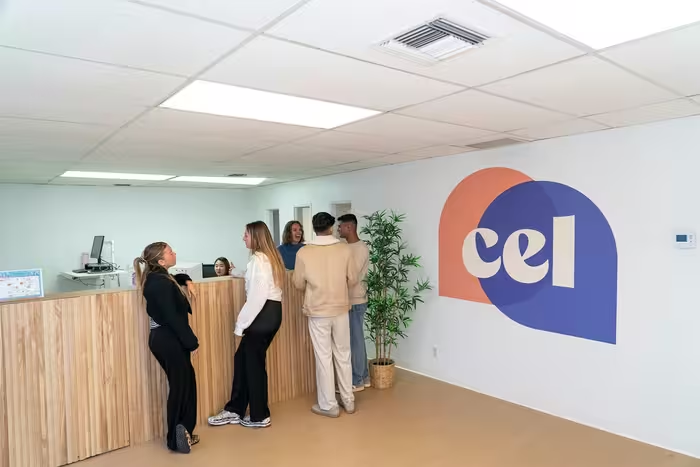
Arrive at 8:30 AM, fifteen minutes before the first class at 8:45 AM. That gives you time to find your classroom and meet reception. The San Diego campus is on the second floor at 945 Hornblend St in Pacific Beach. The Vancouver campus is at 1190 Melville St, 3rd Floor, Suite 300, in Coal Harbour on the edge of Downtown.
Placement test: online before arrival, or written on Monday?
Take the placement test online before arrival. The written version on Monday morning is only a backup. There is no advantage to skipping the online version — the test places you at the correct level on the CEFR scale, the international standard from A1 (beginner) to C2 (advanced).
The placement test has two formats. The online version, completed in the weeks before your flight, means you walk into the right class on Monday without delay. The written version on Monday morning is taken onsite, and uses part of your first class.
If you're unsure what level you might be placed at, [the guide to CEFR English levels] explains the system and what each level typically means.
What does orientation cover?
On Monday at CEL San Diego or Vancouver, orientation runs from 12:30 PM to 2:00 PM, replacing the midday class block for new students. It covers how classes work, how to book activities, who to ask for help, and a short tour of the school. Key staff introduce themselves so you know who to approach later in the week.
Two additional sessions follow, depending on your situation.
Student visa orientation is for F-1 visa students in San Diego and Study Permit or Working Holiday visa students in Vancouver. It covers attendance rules, reporting obligations, and I-20 or Study Permit compliance. CEL San Diego is accredited by CEA (Commission on English Language Program Accreditation) and is authorized by SEVP to issue I-20 forms for F-1 students. CEL Vancouver is a member of Languages Canada.
CEL shared-apartment orientation runs in San Diego only, for students booked into CEL shared apartments. It covers house rules and, if not paid online before arrival, the housing deposit.
Your first class: meeting your teacher and classmates
The first class has no fixed script, but it follows a predictable pattern. The teacher introduces themselves. Each student introduces themselves — usually name, country, and a reason for studying English.
Class sizes at CEL San Diego and Vancouver average seven students and are capped at twelve. On Day 1 this has a specific effect: you'll know every classmate's name and home country by the end of your first hour. The guide to small class sizes in language schools explains the structural reasons in more detail.
A typical Monday afternoon: you leave your first class with a schedule on your phone, two or three classmates already planning Tuesday lunch with you, and the tired feeling that comes from speaking a second language for four hours. In San Diego, many students walk down to the Pacific Beach boardwalk to take a break. In Vancouver, the Coal Harbour seawall is five minutes from campus and leads into Stanley Park.

Tuesday to Friday: The Weekly Rhythm
What does a typical day look like?
Most students follow the morning timetable. Classes run in 90-minute segments with a short break in between.
| Time | Activity |
|---|---|
| 8:45 AM – 10:15 AM | Class |
| 10:15 AM – 10:30 AM | Break |
| 10:30 AM – 12:00 PM | Class |
| 12:00 PM – 12:30 PM | Lunch |
| 12:30 PM onwards | Free afternoon (some course types have additional afternoon classes) |
In high season (roughly June through August), some students are placed in the afternoon timetable instead — classes from 2:15 PM to 5:30 PM. Students cannot choose their block; it is assigned based on availability and course type.
Homework and classmate dynamics
Homework exists but is modest — usually 20 to 40 minutes of reading, writing, or exercises to consolidate the day's class. Most students find it manageable alongside afternoons at the beach, in parks, or exploring the city.
Name recall gets easier fast. By Tuesday, you'll remember most classmates. By Wednesday, lunch groups form naturally. Small classes make this happen without effort.
Weekday social activities
CEL runs social activities most weekdays after class, bookable through the CEL App. In San Diego, examples include beach bike rides, sports on the sand at Pacific Beach, BBQs in local parks, baseball at Petco Park, and hockey games. In Vancouver, typical options include Stanley Park walks, Granville Island, Gastown, Yaletown, and the Museum of Vancouver.
Weekend excursions — longer trips to Las Vegas, San Francisco, or Los Angeles from San Diego, or to Whistler, Victoria, and Seattle from Vancouver — are booked at reception, because CEL runs them with an external activity partner.
Your First Full Weekend: What's Available
School-organized trips
The first full weekend is typically your second weekend in the country. By now you have classmates and you know the neighborhood. Weekend trips depart Friday evening or Saturday morning. From San Diego, Las Vegas (around 5 hours by road) and Los Angeles (around 2.5 hours) are common. From Vancouver, Whistler (around 2 hours by bus) is the most popular, with Seattle and Victoria also available.

What students commonly do independently
Many students skip organized trips their first weekend and explore locally. In San Diego that often means Balboa Park, La Jolla, Coronado, or Mission Bay. In Vancouver, Stanley Park seawall, Capilano Suspension Bridge, or a half-day to the North Shore are the most common first-weekend choices.
What Most Students Worry About (and Why It Fades)
Five worries come up repeatedly. None last past Week 1.
- Jet lag meeting the placement test. The strongest reason to take the online test before you fly.
- Understanding the teacher. The first 20 minutes of Class 1 feel the hardest. By the end of the first session, your listening becomes easier.
- Shyness on Day 1. You won’t be the only one arriving. Each week, several new students start at the school, often at different levels, so you may not all be in the same class. But they’re in the same situation—new environment, new people, speaking a second language. And everyone already there has gone through that exact first day. That shared experience is why connections tend to form quickly.
- Homesickness around Wednesday. The middle of Week 1 is when the novelty dips. Staying social, rather than isolated, is the fix most students report.
- The first weekend feeling uncertain. School activities are the easiest solution — you are placed with other students who already have shared plans.
Longer-term adjustment beyond Week 1 is covered separately in the guide to culture shock for international students.
If you're booked for San Diego
- Campus: 945 Hornblend St, 2nd floor, Pacific Beach (10–15 minutes by Uber from San Diego International Airport).
- Transit card: PRONTO App — works on buses and the Trolley.
- Airport to housing: Uber or Lyft is the standard; CEL airport transfer is bookable.
- First-weekend options: Balboa Park, La Jolla, Coronado; weekend trips to Las Vegas, Los Angeles, or San Francisco.

If you're booked for Vancouver
- Campus: 1190 Melville St, suite 300, Coal Harbour, Downtown Vancouver.
- Transit card: Compass Card — available at any Skytrain station.
- Airport to housing: Uber (easier with luggage) or Canada Line Skytrain from YVR (around CA$8 one-way).
- First-weekend options: Stanley Park, Granville Island, Capilano; weekend trips to Whistler, Seattle, or Victoria.

FAQ — First Week at an English School Abroad
What happens if my flight is delayed and I arrive at school late on Monday?
Contact CEL as soon as possible using the emergency number in your booking confirmation. You will still receive orientation, placement, and either a shortened first class or a Tuesday start. Missing Monday is not a serious problem, but informing the school in advance is important.
Do I still need to take the placement test if I already know my English level?
Yes. The placement test is required even if you hold a recent CEFR certificate or an IELTS or Cambridge score. It ensures you are placed with classmates at the same level. Taking it online before arrival takes less than 30 minutes.
Can I change my class level if the first day feels too easy or too difficult?
Yes. Your level is carefully assigned based on your placement test. In rare cases, adjustments are needed once you start using English in class. If your level doesn’t feel right, speak to your teacher or reception. Reassessment is straightforward, and level changes can be arranged quickly when needed.
What if I don't understand the teacher on the first day?
The first 20 minutes are the hardest. Most students report their listening becoming easier within a single class. If you still struggle after Day 2, the issue is likely class-level placement rather than listening skill — ask to be reassessed.
Is the first weekend lonely if I don't know anyone yet?
Not if you use the school activities. CEL runs weekday social events and weekend excursions that place you with other students who already have shared plans. By Friday of Week 1 most students have a small group of classmates they spend time with outside class.
Moving Into Week 2
By Friday of your first week, the placement test, orientation, and early shyness are behind you. You know your classroom, your teacher's name, and the route between your housing and campus. The city is no longer unfamiliar.
By the end of Week 1, you have a clear sense of how the rest of your course will run. CEL offers programs from one week to 52 weeks at both campuses. You can explore English courses at CEL San Diego or CEL Vancouver — both pages list every available course type — or browse the full Courses page to see how the first week fits into the longer program.










.avif)
