


San Diego is often described as a beach city — and it is. But what surprises most international students when they arrive is how many different cultures live side by side here. San Diego is one of the most culturally diverse cities in California, and that diversity directly shapes your experience as a language student. It affects what you eat, who you meet, and how quickly your English improves.
If you're considering a language stay in San Diego, the cultural mix is one of the strongest reasons to choose this city. Here's what that actually looks like in daily life.
Why Is San Diego So Culturally Diverse?
San Diego sits just 17 miles from the Mexican border, and that proximity defines the city's character. Mexican culture is woven into the architecture, the food, and the rhythm of daily life. You'll notice it the first time you walk through Old Town or order carne asada fries from a roadside stand at midnight.
But the diversity goes far beyond the Mexican-American influence. San Diego is home to large communities from:
- The Philippines, Vietnam, China, and Korea
- East Africa and parts of the Middle East
- Brazil, Colombia, Mexico, and across Latin America
Add the international student populations of UC San Diego and San Diego State, and the result is a city where global perspectives are part of daily life — not an occasional novelty.
For language students, this matters in a practical way. Most of your English practice happens outside the classroom. In San Diego, those daily interactions involve people from many different countries and backgrounds — which means you use English constantly, with a wide variety of accents and conversation styles.
The Neighborhoods That Make San Diego Feel Like Five Cities in One
One of the things CEL students discover quickly is that each San Diego neighborhood has its own character. Exploring them is one of the best ways to experience the city's cultural depth — and to practice English in different real-world contexts.
Pacific Beach — where CEL's campus is located. Relaxed, young, surfer-friendly. Boardwalk cafes, smoothie bowls, and sunset sessions on the pier. The perfect home base for students.
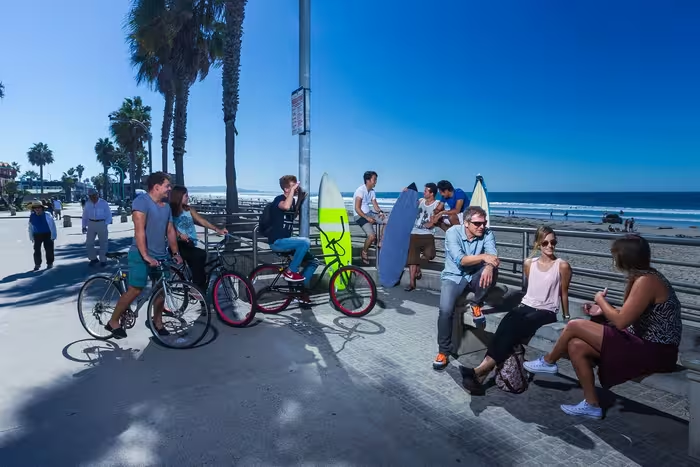
Old Town — the historical heart of San Diego and the birthplace of California. Mexican and early American history meet here. Traditional restaurants, cultural museums, and live folk music.
Little Italy — once a fishing village settled by Italian immigrants in the early 1900s. Today it's known for its food scene, specialty coffee shops, and the weekly Mercato farmers market.
Convoy District — San Diego's Asian food and culture hub, located about 15 minutes north of downtown. Korean barbecue, Japanese ramen, Chinese dim sum, Filipino bakeries, and Thai street food are all within a few blocks. Ordering in English at a busy Convoy restaurant is excellent real-world practice.
Gaslamp Quarter — the downtown entertainment district. Bars, rooftop restaurants, live music, and street performers. The area comes alive in the evening.
North Park — one of the city's most creative neighborhoods. Independent coffee shops, vintage stores, street art, and a strong local food scene. Walkable, affordable, and full of character.
Each of these neighborhoods offers a different experience — different vocabulary, different social settings, and different ways to use your English. Exploring them is part of the learning experience.
Why Diversity Speeds Up Your English Progress
There's a practical reason cultural diversity matters for language learners — beyond the obvious richness of experience.
It forces you to use English as a real communication tool, not just a classroom exercise.
In a city where your classmates come from Brazil, Japan, Switzerland, and Saudi Arabia, English isn't anyone's first language. It's the shared language that connects everyone. This is exactly how fluency develops. You stop translating in your head and start thinking in English because you have to.
At CEL, the small class sizes — an average of 7 students per class, with a maximum of 12 — mean you get real speaking time during lessons. But the learning continues after class: at a taco shop, at the beach, on a weekend trip to Joshua Tree National Park, two hours east of the city.
San Diego's diversity ensures these after-class interactions happen in English, with people from backgrounds completely different from your own. The variety of accents, communication styles, and cultural references you encounter every day builds practical fluency that classroom hours alone cannot deliver.

The Food Tells the Story
You can trace San Diego's cultural history through its food. Mexican cuisine is the foundation — the city has some of the best Mexican food in the United States, thanks to its border location and deep cultural roots. But the food scene extends well beyond that.
In a single day, you could have:
- Açaí bowls for breakfast in Pacific Beach
- Pho for lunch in Convoy
- An Italian aperitivo (a light pre-dinner drink with snacks) in Little Italy
- Fish tacos from a stand in Ocean Beach for dinner
Each meal comes with a different atmosphere, different people, and different conversations.
For language students, food is often the easiest entry point into a new culture. Ordering at a busy counter, asking a server about ingredients, discussing a dish with your flatmates — these are simple, low-pressure moments to practice English. San Diego's food diversity gives you more of these moments than almost any other city on the West Coast.

A Multilingual City Where English Is the Common Thread
San Diego is not a monolingual city. Spanish is everywhere — on signs, in conversations, in the music drifting from open car windows. You'll also hear Tagalog, Vietnamese, Arabic, Mandarin, and many other languages depending on which neighborhood you're in.
For language students, this might sound like a disadvantage. If many people speak multiple languages, will you really be forced to use English?
The answer is yes — precisely because of the diversity. When you're having dinner with a Brazilian, a Korean, and a German, the only language everyone shares is English. The multilingual environment actually reinforces English as the essential connecting language.
It also means you're surrounded by people who understand what it's like to learn a language. San Diego residents are used to hearing accented English and are generally patient with non-native speakers. That creates a supportive environment for learners.
What This Means for Your Language Stay
San Diego's diversity isn't just a nice feature. It directly shapes the quality of your English learning experience in the USA.
You're learning English in a city where cross-cultural communication happens constantly. Your host family might be Mexican-American or have grown up somewhere else in the United States. Your classmates will come from countries you may never have visited. Your weekend trips will take you through neighborhoods that feel like different countries.
This kind of exposure builds more than language skills. It builds the practical ability to communicate across cultural differences — a skill that employers value long after your course ends. CEL is SEVP-certified and welcomes students from around the world year-round, so this international mix is a constant feature of the school, not a seasonal one.
Ready to experience San Diego's diversity for yourself? Explore CEL's English courses in San Diego or contact our admissions team to discuss the right program for your level and goals.

Frequently Asked Questions
Is San Diego more diverse than Los Angeles?
Los Angeles is larger and has more total diversity in absolute numbers. But San Diego's diversity is more accessible and integrated into daily life. The city is smaller and more walkable, which means you encounter different cultures naturally, without having to seek them out. For language students, this matters — San Diego's size makes immersion easier.
Will I mostly hear Spanish in San Diego?
English is the dominant language in San Diego. Spanish is widely spoken, especially near the border and in certain neighborhoods, but day-to-day interactions in shops, restaurants, and on campus happen in English. The bilingual environment is a bonus, not a barrier.
What nationalities study at CEL San Diego?
CEL welcomes students from many countries, including Brazil, Japan, South Korea, Switzerland, Germany, France, Saudi Arabia, Colombia, and others. The international mix changes by season, but the classroom is always globally diverse.
Will I be the only student from my country at CEL?
This depends on the season and your country. Major source markets like Brazil, Japan, and Switzerland usually have several students at any given time. Smaller markets may have one or two. CEL's small class sizes (average 7, maximum 12) mean you'll always be working closely with students from different backgrounds, regardless of the specific mix.
Is San Diego a good city for students on a budget?
San Diego is more affordable than Los Angeles or San Francisco, though it's not a cheap city. Neighborhoods like Pacific Beach offer a good balance of student-friendly pricing and quality of life. For a detailed breakdown, see our guide on studying in California on a student budget.



.avif)
.avif)


.avif)
