Categories
English

Present Simple Or Present Continuous: Which One Do I Use?

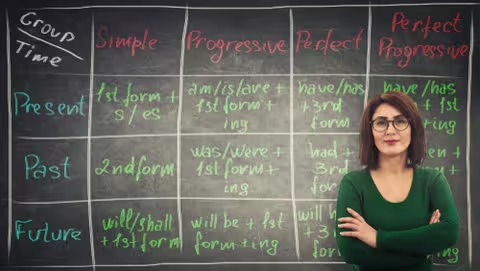
College of English Language in San Diego provides comprehensive English instruction, including mastering present and past tenses, helping students confidently navigate real-world communication.

So, Present Simple or Present Continuous? It sounds easier than getting to know all the main tenses in English, using these tenses adequately, and mastering every past tense there is. But is it? Is there such a thing as easy grammar when you’re just starting out?

We feel there isn’t, and sometimes, the best course of action is to find a good English language school in San Diego, California, and start from there. But, for now, let’s see how we can help.

Contact us online and get a quote today or call us via WhatsApp!
Get a Quote

WhatsApp: +1 619 519 5835

__wf_reserved_inherit

WHERE DO WE USE PRESENT SIMPLE TENSE?

Present Simple Tense is, basically, the most commonly used tense in English, and also the easiest one to master. You don’t need to be a member of the University of California Department of Linguistics to be able to use Present Simple aptly.

However, while that may be true for its basic use, there are some ways in which you can employ Present Simple Tense that are neither easy nor common.

  1. General truths - If something is always true, use Present Simple Tense. See, we’ve even used it in this sentence. For example - “Five plus five equals ten.”, or “People need water.”.
  2. Habitual actions - If a person performs a certain action on a more or less frequent basis, we’ll use Present Simple Tense. So, it’s always “I play basketball three times a week.” or “She goes to school every day.”.
  3. Commentary - This is where we’re going to confuse you. As we’ll see later on, Present Continuous Tense is used to describe actions happening right now. But, when it comes to, let’s say, sports commentary, you’ll use Present Simple - “Neymar takes the ball, he runs toward the keeper, he shoots, he scores!”.
  4. Unchangeable future - When talking about future events, but ones set in stone, you use Present Simple Tense before any other - “The train leaves the station at eight.”, or “What time does school begin?”.
  5. Temporal clauses - Any time you’re providing a clear timeframe, Present Simple is in the house. So, when using conjunctions such as “until”, “when”, “before”, “as soon as”, and “after”, always stick to this tense - “I’ll come back home when I finish work.”, or “She’ll call you before her plane leaves for Mexico.”.
  6. Conditional sentences - Present Simple Tense is used in the zero and the first conditional without exception - “If you heat snow it melts.” and “I won’t be able to go out if it rains.”.

WHY DO WE USE PRESENT CONTINUOUS TENSE?

Well, because you have to, right? We mean, it’s there, why not use it? That’s one reason, and the other one is that you can’t avoid it. No sir. But, to be serious, let’s explain a bit further.

It’s not that you have to use it, even though you do have to, but it’s that there is no other tense in the English language that is able to express what the Present Continuous Tense can.

If you’re trying to talk about an action happening now, or if you’re trying to make plans for the future, you need to employ Present Continuous Tense to properly express your thoughts. So, perhaps the better question would be “When do we use Present Continuous Tense?”.

WHEN DO WE USE PRESENT CONTINUOUS TENSE?

So, now you know that there’s no way around the Present Continuous Tense. The situation being as it is, let’s see when you can use it, or rather have to use it. Just kidding, you don’t have to, but you should. A gentler suggestion on our part, nothing more.

  1. Now! - When you’re trying to describe an action happening as you’re speaking, similar to what we’ve just done, use Present Continuous - “He’s listening to music at the moment.”, or “What are you doing?”.
  2. Temporary situations - Even when something’s not happening right now, but is temporary, no matter for how long it’s been going on, use Present Continuous - “He’s working as a waiter until he finds a better job.”, or “I’m staying with my parents for the weekend.”. For example, if you were to use Present Simple Tense for the first sentence, “He works as a waiter…”, that would mean that his job is considered permanent, not temporary.
  3. Annoyance - If something keeps happening, and you’re not exactly happy about it, even though it is a habitual action you’ll use Present Continuous Tense to express your dislike of it - “He’s always forgetting where he parked his car.”, or “I’m constantly missing the bus!”. Yes, you can be annoyed with yourself as well.
  4. Future plans - If you’re making a plan for the future, and the plan is as good as definite, use this tense - “I’m playing football tomorrow.”, or “She’s traveling to Morocco tomorrow.”.

WHAT IS CONTINUOUS ACTION?

Finally, an easy question we can answer in a jiffy. Continuous action is an action that either was in progress for a certain amount of time, is in progress right now, or will be in progress at a certain point in the future.

So, it doesn’t matter if it happened in the past, if it’s happening presently, or if it’s going to happen in the future - if it lasts for a certain amount of time, or lasted, or will last, it’s continuous action. The duration of the action is the only prerequisite for it to be called “continuous”. And that’s it, nothing more to it. Easy peasy lemon squeezy!

“I GET IT, BUT IS THERE A LANGUAGE SCHOOL WHERE I COULD LEARN ALL THIS?”

If you’re looking for the best private school for English language in San Diego, California, you needn’t look further - College of English Language is the perfect place for you! Mastering the present, past, and future tenses will be a breeze with our stellar staff and state-of-the-art teaching equipment. So, if you want to be able to explore Embarcadero and understand everything it has to offer, stop by our school and we’ll help you out!


Frequently Asked Questions

Patrick
Patrick
Himmelberg
CEO
Patrick
Becoming Fluent In English: How To Improve Speaking And Writing Skills

Becoming Fluent In English: How To Improve Speaking And Writing Skills

Improve your English speaking and writing skills effectively at the College of English Language in Los Angeles, with personalized instruction, modern teaching methods, and a supportive learning environment.

What's Your Purpose In Studying Abroad?

What's Your Purpose In Studying Abroad?

Before selecting a destination for studying abroad, it's essential to define your learning goals and evaluate how the experience will benefit you in the future.

Local Life in San Diego – Leben wie ein Local

Local Life in San Diego – Leben wie ein Local

Lebe den kalifornischen Traum bei deinem Sprachaufenthalt in San Diego. Nur fünf Minuten vom Meer entfernt lernst du Englisch in kleinen Klassen, genießt Sonne, Strand und den echten Local-Lifestyle. Ob Surfen am Morgen, Tacos am Abend oder Wochenendtrips mit neuen Freunden – in San Diego wird Englischlernen zum Erlebnis.

Famille d’accueil ou colocation ? Comment le logement influence votre séjour linguistique

Famille d’accueil ou colocation ? Comment le logement influence votre séjour linguistique

Guide décisionnel pour choisir entre famille d’accueil et colocation lors d’un séjour linguistique à Vancouver ou San Diego.

USA o Canada per imparare l’inglese? Come scegliere il soggiorno linguistico giusto

USA o Canada per imparare l’inglese? Come scegliere il soggiorno linguistico giusto

Una guida equilibrata per scegliere tra USA e Canada per imparare l’inglese. Scopri come è l’ambiente — non solo il Paese — a influenzare il progresso e come applicare il CEL Decision Lens™ alla tua fase di apprendimento.

The Power of Small Talk: Why Mastering Everyday English Boosts Your Career

The Power of Small Talk: Why Mastering Everyday English Boosts Your Career

Small talk isn’t small at all. In the U.S., it’s the key to confidence, connection, and career success. Learn how CEL San Diego helps you turn English into opportunity.

How Long Does It Really Take to Improve Your English Abroad? A Reality Check

How Long Does It Really Take to Improve Your English Abroad? A Reality Check

A realistic, experience-based guide to how long it takes to improve English abroad, using the CEL Progress Curve™ and real student patterns.

Why You Should Choose San Diego Over LA and San Francisco

Why You Should Choose San Diego Over LA and San Francisco

Currently interning at CEL San Diego, I've cherished the diverse friendships and learning opportunities, affirming CEL as California's top language school. From Santa Monica to San Diego, my journey embodies the essence of the West Coast.

2026-05-21
2026-05-21

How to correctly use present simple and present continuous tenses

Understanding when to use the present simple and present continuous tenses is fundamental for clear English communication, especially when describing habits versus actions happening right now. The present simple tense describes general truths, habitual actions like "I play basketball three times a week," sports commentary, unchangeable future events such as "The train leaves at eight," temporal clauses, and zero or first conditional sentences. It's often the easiest tense to master for basic usage, but its use in conditional sentences can sometimes trip up new learners. In contrast, the present continuous tense indicates actions in progress at the moment of speaking ("He's listening to music") or temporary situations, even if not strictly happening "now." It also conveys annoyance ("He’s always forgetting his keys") or definite future plans. Mastering both helps you communicate accurately and avoid common mistakes.

The present simple tense is crucial for everyday communication. It's used for facts, routines, and scheduled events, giving your statements a sense of permanence or regularity. For example, when you say "The sun rises in the east," you're using the present simple to state a universal truth. Similarly, describing your daily routine, such as "I wake up at 7 AM every day," relies on this tense to convey a habitual action. This foundational tense is often among the first concepts taught in general English courses, including those at the College of English Language. It's simpler to form than many other tenses, requiring only the base form of the verb for most subjects, with an added "-s" for third-person singular subjects like "he," "she," or "it." Building a strong grasp of the present simple is a key step toward overall fluency in English.

When should you use the present continuous for future events?

The present continuous is not just for actions happening right now; it also serves a specific role in talking about the future. When you have definite plans, especially those that have been arranged, the present continuous tense is the correct choice. Think of it as a pre-scheduled event that is "in progress" in your calendar. For example, "I'm flying to San Diego, California tomorrow" indicates a confirmed travel plan. This usage is distinct from using "will" for spontaneous decisions or "going to" for intentions. Learning these subtle differences, along with other English grammar rules, is vital for precise communication. An immersive program, such as the ones offered at a language school in San Diego, can provide the context and practice needed to internalize these rules naturally. Such programs help students move beyond memorization to truly understanding when and why to use each tense.

What is a continuous action in English grammar?

A continuous action is any action that was in progress, is currently in progress, or will be in progress over a duration of time. Its key characteristic is its ongoing nature, regardless of whether it occurred in the past, present, or future. This duration is the sole requirement for an action to be classified as "continuous." If you are looking to master these and other tenses, consider an immersive English language program in San Diego, California. The College of English Language offers programs designed to build strong grammatical foundations and develop all four core language skills: speaking, listening, reading, and writing. Our general English courses focus on practical application, ensuring you gain confidence in using tenses like the present simple and continuous accurately. Explore our courses to find the right fit for your learning goals, and experience how dedicated instruction can make mastering English grammar a breeze. Whether you're planning to study in the USA or Canada, understanding core grammar is essential.

Frequently Asked Questions