Categories
English

Simple Future Tense: A Short Guide

Learn the Simple Future Tense for accurate predictions, spontaneous decisions, promises, offers, requests, orders, or threats. It's also used with time clauses and to express willingness. Join our intensive English course in California to master this and more!

Simple Future Tense: A Short Guide

You have been attending an intensive English language course for a while, and now it’s time to learn how to talk about future plans and arrangements. You’ve noticed that many verb forms convey future meanings, so you probably start wondering if you’ll ever be able to use them correctly in your sentences.

Well, don’t worry too much. Your favorite teachers surely have the right approach, and they’ll introduce you to the tenses in a logical order. In the previous blog post, we touched on all future tenses to give you a short introduction to this complex topic. In this article, we’ll provide more details on the Simple Future Tense. Keep reading to learn more!

Contact us online and get a quote today or call us via WhatsApp!

Get a Quote

WhatsApp: +1 619 519 5835

__wf_reserved_inherit

WHAT ARE THE RULES OF THE SIMPLE FUTURE TENSE?

Here is a short guide on how to form the Simple Future Tense.

  • Positive form: will + bare infinitive (infinitive without to): I will go to the dentist’s tomorrow.  
  • Negative form: will not/ won’t + bare infinitive (infinitive without to): She won’t tell you the truth.
  • Interrogative form: will + subject + bare infinitive (infinitive without to): Will you join me tonight?

Note: The formula is the same for all persons: They will go with us tomorrow.

HOW DO YOU USE THE SIMPLE FUTURE IN A SENTENCE?

Now that you know how to form this tense, here is how you can use it correctly in your sentences:

  • You can use it to predict a future event (unlike the be going to form, this prediction is usually based on some personal beliefs).

I am sure she will pass the exam.

  • You can also use it to express a spontaneous decision.

Don’t worry, I will pay for everything if you don’t have any money.

  • This tense is used for unplanned or unavoidable future events.

Winter will come soon.

  • You can make an offer, a promise, a request, an order, or a threat with this tense too.

Offer: I will help you with the dishes.

Promise: I won’t do it again, I promise!

Request: Will you come and help me in the garden? I have to pick some fruit.

Order:  You will do as I say!

Threat: If you do it again, I won't speak with you again!

  • You have to use this tense with time clauses.

When I come back home (time clause), I will give you a call.

  • This tense is used to express the willingness or unwillingness of the subject to do something.

She simply won’t tell the truth!

OK, I will help you with your math problems.

  • You can use shall and the first person singular to make an offer.

Shall I open the window?

  • When used with we and shall in the interrogative form, this construction expresses a suggestion.

Shall we go for a walk tonight?

  • With you in the interrogative form, it is used to make an invitation:

Will you come to the dance with me?

NB: In the past, shall was used instead of will for the first person singular and the first person plural (I shall study tonight. We shall go to see her.). But today, shall is outdated, and it has restricted use. We normally use it to make an offer or a suggestion: Shall we go out tonight?

SIGN UP FOR AN INTENSIVE ENGLISH LANGUAGE COURSE IN ONE OF CALIFORNIA’S MOST POPULAR SCHOOLS

Do you need a comprehensive course to hone your English language skills? If the answer is yes, you have come to the right place! At the College of English Language, we boast incredible teaching methods that will help you understand all tenses, including future continuous tense. What a scary name, right? But with us, you won’t feel lost in the sea of rules. (Note how we used the Simple Future Tense to make a promise.)

Instead, you’ll approach each tense systematically in our hi-tech classrooms in San Diego, Santa Monica, and Pacific Beach, and get a chance to apply what you’ve learned in various fun-packed activities. And then, after classes, you can even pluck up the courage and converse with your new friends while taking a stroll by Mission Beach and enjoying the view. Visit us, and let your language learning journey begin today!


Frequently Asked Questions

Patrick
Patrick
Himmelberg
CEO
Patrick
English
Becoming Fluent In English: How To Improve Speaking And Writing Skills

Becoming Fluent In English: How To Improve Speaking And Writing Skills

Improve your English speaking and writing skills effectively at the College of English Language in Los Angeles, with personalized instruction, modern teaching methods, and a supportive learning environment.

English
What's Your Purpose In Studying Abroad?

What's Your Purpose In Studying Abroad?

Before selecting a destination for studying abroad, it's essential to define your learning goals and evaluate how the experience will benefit you in the future.

Vie locale
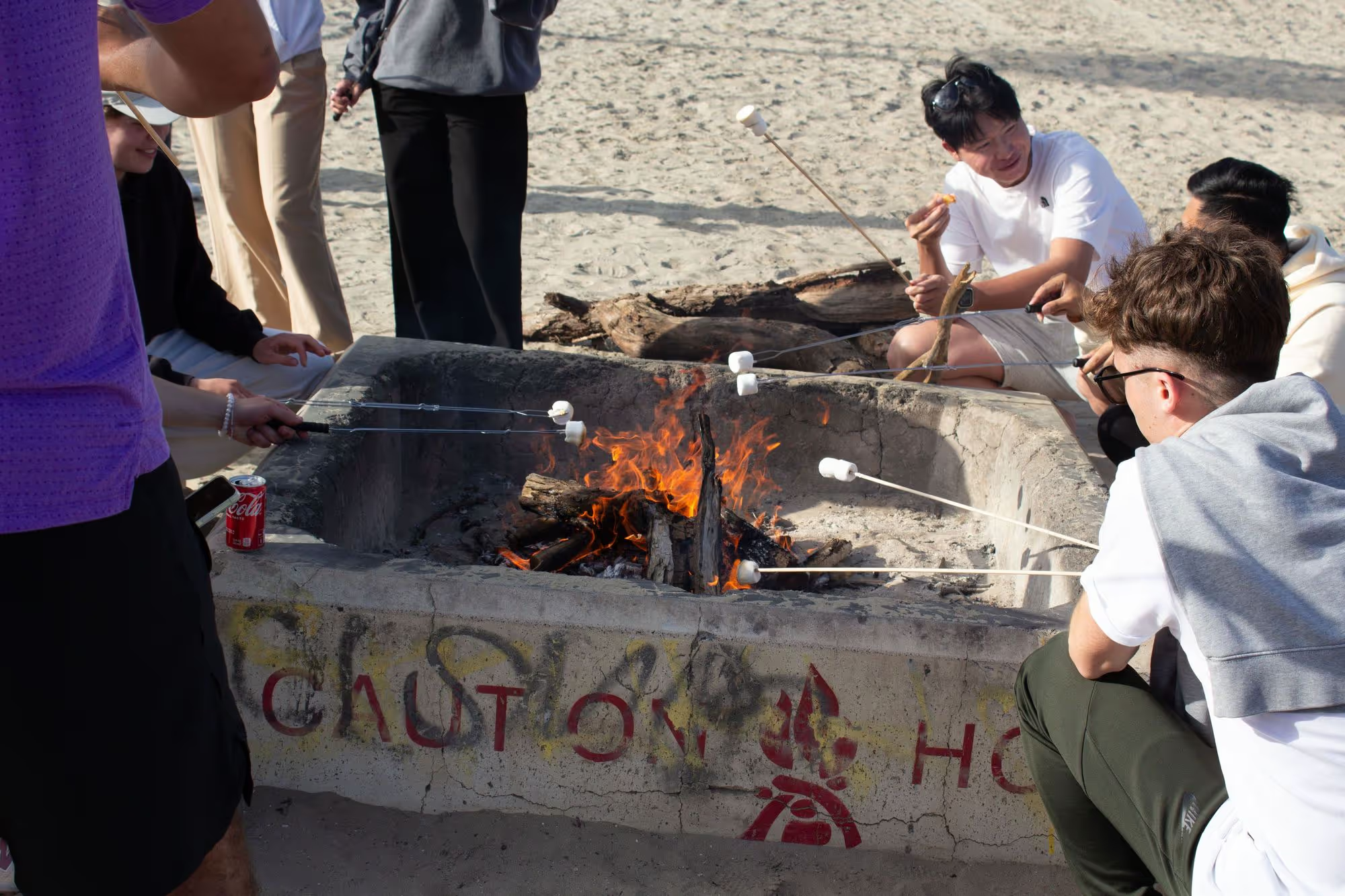
Feu de camp à Mission Beach – Une soirée inoubliable pendant votre séjour linguistique à San Diego

Feu de camp à Mission Beach – Une soirée inoubliable pendant votre séjour linguistique à San Diego

Vivez la magie d’un feu de camp à Mission Beach : un moment unique pour pratiquer votre anglais, rencontrer le monde et savourer votre séjour linguistique à San Diego.

Study Abroad
How to Stay Connected With Friends and Family While Studying Abroad (Without Losing the Experience)

How to Stay Connected With Friends and Family While Studying Abroad (Without Losing the Experience)

Staying in touch during your language stay: keep strong connections with family and friends without missing your experience in Vancouver. Clear routines, time zone tips, and the right balance help you truly settle in.

Lokales Leben
Wie sicher ist San Diego für internationale Sprachschüler?

Wie sicher ist San Diego für internationale Sprachschüler?

San Diego gilt konstant als eine der sichersten US-Grossstädte. Dieser Beitrag zeigt die Kriminalitätsdaten, die Quartiere, in denen CEL-Studierende leben und lernen, sowie die praktischen Sicherheitsgewohnheiten, die im Alltag wirklich zählen.

미국 & 캐나다
미국 문화, 이건 몰랐지? 7가지 놀라운 사실

미국 문화, 이건 몰랐지? 7가지 놀라운 사실

미국 어학연수는 단순한 영어 공부를 넘어, 문화·사람·라이프스타일을 직접 체험하는 경험입니다. Small Talk, 음식 문화, 참여형 수업, 스포츠 열기, 그리고 캘리포니아 특유의 자유로운 라이프까지— 샌디에이고와 LA에서의 어학연수는 미국 문화를 몸으로 이해하며 영어 실력과 자신감을 함께 키우는 시간입니다.

Esperienze degli Studenti
Da studentessa a membro del campus: come una scuola di lingue a San Diego ha cambiato il mio percorso

Da studentessa a membro del campus: come una scuola di lingue a San Diego ha cambiato il mio percorso

Una storia personale di studio in una scuola di lingue a San Diego. Dall’apprendimento dell’inglese in California al coinvolgimento nella vita del campus, questa esperienza mostra come un corso di inglese possa portare a crescita, sicurezza e connessioni internazionali.

Vie locale
Que faire à Vancouver après les cours d’anglais pendant votre séjour linguistique

Que faire à Vancouver après les cours d’anglais pendant votre séjour linguistique

Découvrez que faire à Vancouver après vos cours d’anglais pendant votre séjour linguistique. Activités outdoor, vie quotidienne et conseils pour pratiquer l’anglais naturellement en dehors de la salle de classe.

2026-06-02
2026-06-02

How to Use the Simple Future Tense Effectively in English?

The simple future tense, formed with "will" + the bare infinitive of a verb, helps express predictions, spontaneous decisions, unplanned events, and offers. For instance, "I will go to the dentist tomorrow" shows a planned action. This tense is versatile, also used for promises like "I won’t do it again," requests such as "Will you join me tonight?", and even threats. While "shall" was historically used for the first person singular and plural, its use is now largely limited to making offers or suggestions, like "Shall we go for a walk tonight?" This post breaks down forming and applying the simple future in everyday English. Mastering it is a key step in developing strong communication skills, allowing you to articulate future plans, commitments, and possibilities with clarity. It’s a core component of many intensive English language courses.

Learning to correctly use the simple future tense involves more than just memorizing formulas; it requires understanding the context and intent behind your statements. For instance, predictions based on personal belief ("I am sure she will pass the exam") contrast with those based on concrete evidence, which often use "be going to." When you make a decision in the moment, such as "Don’t worry, I will pay for everything," the simple future is the appropriate form. Similarly, describing unavoidable events, like "Winter will come soon," consistently uses this tense. It is also essential to use this tense correctly with time clauses, for example, "When I come back home, I will give you a call." Many students find these nuances challenging, but dedicated practice through structured programs like those offered at the College of English Language can make a significant difference.

Mastering the Simple Future for Clear Communication

To master the simple future, focus on its distinct uses: predicting future events based on personal belief ("I am sure she will pass the exam"), expressing a decision made at the moment of speaking ("Don’t worry, I will pay for everything"), or stating an unavoidable event ("Winter will come soon"). You'll also use it with time clauses, as in "When I come back home, I will give you a call." Understanding these contexts helps to distinguish the simple future from other ways to express future events. The proper application of this tense is vital for any English learner looking to communicate clearly and confidently about future actions and intentions. This foundational grammar topic is often covered in general English courses and is crucial for preparing for exams like the TOEFL iBT or Cambridge English.

Applying Simple Future in Real-World Scenarios

The simple future also plays a strong role in expressing willingness or unwillingness, such as "She simply won’t tell the truth!" or "OK, I will help you with your math problems." This flexibility makes it indispensable for everyday conversations and more formal settings. Teachers at language schools like CEL integrate real-life scenarios into their lessons, ensuring students grasp these complexities beyond textbook definitions. For example, in San Diego, California, students might practice making offers or suggestions to new friends while exploring local attractions. Understanding these rules is a vital step toward fluency and confidence, enabling you to participate fully in conversations and express your thoughts accurately. Whether you're making plans, promises, or predictions, a solid grasp of this tense is key to effective communication. Explore CEL's diverse courses to improve your grammar and speaking skills, or consider our English for global careers programs for specific professional language needs. For more tips on grammar, read our post on common mistakes learners make forming conditionals.

Frequently Asked Questions